In 1895 Frederick Cowling, aged 27, was appointed Headmaster of the science school in Clay Lane, Clay Cross, Derbyshire1. The 1895 Kelly’s Directory for Derbyshire & Nottinghamshire records that it was a mixed science school with a capacity to hold 130 and had been recently fitted out following acquisition of the Clay Cross Schools, which comprised also senior boys’ and girls’, junior boys’ and girls’ schools, and an infants’ school, by the School Board in 1892.
Some of Frederick’s work at the school is recorded in a number of local newspaper articles over the late 1890s and early 1900s. In 1898, at the school’s annual prize giving, a concert was given under Frederick’s conductorship and in the school’s annual report he remarked that the school was in a “flourishing condition” as regards [student] numbers2. In 1899 Frederick is reported as having delivered “An interesting paper, with demonstrations on ‘Science Teaching and Object Lessons” at a bi-monthly meeting of the East Derbyshire Teachers’ Association3. In 1900 the Association held one of its meetings at the Clay Cross school where, it seems, Frederick provided a guided tour of the school’s science laboratories4. Later the same year a notice appeared inviting applications for admission by 3rd September, noting “Headmaster F. Cowling F.C.S. Science Honours, Chemistry, Physiography, Hygiene”5. In 1902 Frederick represented the school at the funeral of a local publican and member of the Clay Lane School Board6. In later decades, retrospective articles in the local press acknowledge Frederick’s and others’ contribution to the development of education provision at the Clay Cross school7 and record the appointment in July 1917 of Frederick’s successor as Headmaster, Mr. George Selkirk Hollister.
In 1904 Fredrick’s nomination for election to the Clay Cross Urban District Council was reported8 and his continued presence on the Council is apparent in a further newspaper report in 19099. The 1912 Kelly’s Directory for Derbyshire also records Frederick’s membership of Clay Cross Urban District Council and the local newspaper articles also provide evidence of some of Frederick’s work as a councillor and of his other local political activity. In 1901 Frederick attended a speech given by Thomas Bayley, Liberal Party M.P. for the constituency of Chesterfield from 1892-1906, in which the M.P. set out his opposition to the Coal Tax, described the House of Lords’ action in frustrating a Bill (with regard to Poor Law relief payments) which had unanimous support of the House of Commons, pledged support for parental control of schools, and spoke of the cost in lives and money of the ongoing war in South Africa10. In 1903 Frederick is reported as attending a meeting of Clay Cross Urban District Council to formulate a scheme for implementing the Education Act locally11, and as having himself given an address on Chamberlain’s fiscal policy12. In the reported address Frederick makes an impassioned case for free trade versus the Conservative Party policy of preferential tariffs, as well as touching on the balance of trade deficit and profligate spending on the Police and local authorities.
In late 1904 Frederick’s name appears three times in the local press. Two of these record Frederick’s active participation in meetings at Clay Cross addressed by local M.P. Thomas Bayley in which the sugar convention, a dispute by Post Office officials, Chinese labour, education and tariff reform were all debated13. On Christmas Eve, Frederick is reported as having given a lecture on the “Wisdom of Ants” with the assistance of a lantern projectionist14.
Local press reports during 1905 show Frederick’s continued participation in local council business as a member of Clay Cross Urban District Council. A detailed report reveals that Frederick was the Council’s chief protagonist in a heated dispute with a Newcastle engineer over apparent flaws in the construction of the Clay Cross sewage scheme, and records Frederick’s appointment to a new sub-committee set up to consider the extension of the administrative reach of the District Council15. In a meeting of another committee, Frederick is reported as blaming inadequate remuneration for the absence of sub-post offices in the town, and the committee as a whole is reported as voting in support of Sunday postal deliveries16. The following year, Frederick’s presence at a meeting of representatives of the parishes in the Clay Cross School district area is also reported17.
In the run up to the 1906 general election, local press reports document Frederick’s engagement with the wider political issues of the day. At a meeting organised jointly by the Clay Cross Branch of the Gasworkers’ and General Labourers’ Union and the Clay Cross Labour Council, Frederick is reported as joining others on a platform that heard an address by Pete Curran, Labour candidate for Jarrow, on the advantages of belonging to a Trades Union18. Frederick is reported as one of three speakers at a meeting in Woolley village, where questions of free trade, the South Africa war and Home Rule for Ireland were raised among others19. And, back at Clay Cross, Frederick is reported as presiding over another meeting organised jointly by the Clay Cross Branch of the Gasworkers’ and General Labourers’ Union and the Clay Cross Labour Council, again with Pete Curran present, in which it was alleged that Mr. Jackson of the Clay Cross Company was not co-operating with union representatives, and urging voters not to be intimated against voting for their Labour candidate20.
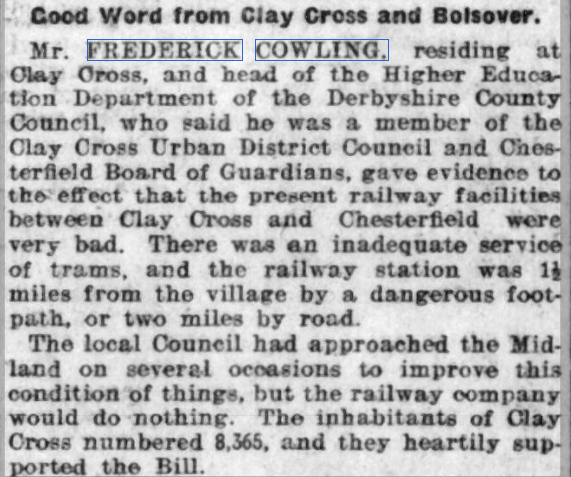
In 1913 Frederick is reported as having given evidence to a House of Commons Select Committee in support of Chesterfield Corporation’s Railless21 Traction Bill:
Other reports document the Cowlings’ involvement in the community of Clay Cross. In 1898 Frederick and Susannah are named among those that attended a fancy dress ball held at Clay Cross Town Hall “…under the stewardship of …Mr. W. B. M. Jackson [and]…Mr. G. M. Jackson..”22, and Susannah is reported as attending the wedding at Clay Cross Parish Church of Mr. J. Blagg, of Creswell, and Miss Dora Edge, of Clay Cross, gifting to the couple an ‘afternoon tea cloth’23. In 1904, Frederick and Susannah attended the Clay Cross Volunteer Ball, an event organised by “G” Company of the 2nd Volunteer Battalion, Sherwood Foresters, Notts and Derbyshire Regiment, where “a pleasing programme of 24 dances had been arranged, and dancing kept up with great spirit until three o’clock in the morning…”24. In 1905 Frederick is recorded as one of the public representatives attending the funeral of a local resident Mr. J. Dickinson25, and the following year he is named as one of the members of the Clay Cross Floral and Horticultural Society26. The same report records that the president of the Society is Col. G. M. Jackson J.P.
Footnotes:
- Derbyshire Times and Chesterfield Herald 29 March 1935 ‘NEW CLAY CROSS SECONDARY SCHOOL STONE-LAYING CEREMONY NEXT WEDNESDAY’. ↩︎
- Derbyshire Times and Chesterfield Herald 19 November 1898. ↩︎
- Derbyshire Times and Chesterfield Herald 01 April 1899. ↩︎
- Derbyshire Times and Chesterfield Herald 24 March 1900. ↩︎
- Derbyshire Times and Chesterfield Herald 25 August 1900. ↩︎
- Derbyshire Times and Chesterfield Herald 14 June 1902. ↩︎
- Derbyshire Times and Chesterfield Herald 27 December 1930, Derbyshire Times and Chesterfield Herald 29 March 1935 and Derbyshire Times and Chesterfield Herald 05 April 1935. ↩︎
- Derbyshire Courier, 12March 1904. ↩︎
- Derbyshire Courier, 20 March 1909. ↩︎
- Derbyshire Times and Chesterfield Herald 16 November 1901. ↩︎
- Derbyshire Times and Chesterfield Herald 16 May 1903. ↩︎
- Derbyshire Times and Chesterfield Herald 18 November 1903. Chamberlain’s Shibboleth. “Will die the death of a dog”. Liberal address at Clay Cross. Under the auspices of the Clay Cross Liberal Association, Mr. F. Cowling F.C.S. gave an address on the fiscal policy in the Clay Cross Primitive Methodist School on Friday evening last. Mr. F. Kenning, J.P., presided. ↩︎
- Sheffield Daily Telegraph 10 December 1904 and Derbyshire Times and Chesterfield Herald 17 December 1904. ↩︎
- Derbyshire Times and Chesterfield Herald 24 December 1904. ↩︎
- Derbyshire Times and Chesterfield Herald 04 March 1905. ↩︎
- Derbyshire Times and Chesterfield Herald 11 March 1905. ↩︎
- Derbyshire Times and Chesterfield Herald 13 May 1905. ↩︎
- Derbyshire Times and Chesterfield Herald 21 October 1905. ↩︎
- Derbyshire Times and Chesterfield Herald 13 January 1906. ↩︎
- Derbyshire Times and Chesterfield Herald 24 March 1906. ↩︎
- More information about railless traction transport of the period is available here: https://en.wikipedia.org/wiki/Railless ↩︎
- Derbyshire Times and Chesterfield Herald 16 April 1898. ↩︎
- Derbyshire Times and Chesterfield Herald 20 August 1898. ↩︎
- Derbyshire Times and Chesterfield Herald 06 February 1904. ↩︎
- Derbyshire Times and Chesterfield Herald 25 March 1905. ↩︎
- Derbyshire Times and Chesterfield Herald 18 August 1906. ↩︎
 141 Upperton Road